



Plasma is a fascinating discovery in science, first found by British scientist Sir William Crookes in 1879. It forms when intense heat breaks atomic bonds. This creates a unique mix of charged particles.
It’s known as the fourth state of matter. This ionised gas has special properties. These properties are different from solids, liquids, and regular gases.
Plasma technology is used in many areas. It’s found in TV displays and advanced medical sterilisation systems. This technology uses basic physical principles to achieve amazing results.
Learning about plasma’s basics helps us understand its many uses. From being a lab curiosity to a practical innovation, it shows human creativity at its best.
What is Plasma? The Fourth State of Matter
Plasma is a state of matter that’s not as well-known as solid, liquid, and gas. It’s the most common form in the universe, making up about 99% of what we can see. You can find plasma in stars and in our atmosphere, showing its importance and beauty.
Defining Plasma and Its Unique Properties
Plasma is created when gases lose their electrons, turning into a mix of charged particles. This change makes plasma different from regular gas. It has free electrons, positive ions, and neutral particles.
The properties of plasma are special. It can carry electric currents and respond to magnetic fields. This makes it useful for many technologies that need to control energy.
Plasma also acts as a whole, not just as individual particles. The charged particles in plasma interact with each other, creating waves and patterns. This is unlike the simple interactions seen in other states of matter.
Related Posts:
- Should We Use Technology in the Classroom The Modern…

- How to Get Into Technology A Beginner's Career Guide

- A Technological Innovation in Healthcare…

- How Technology Has Affected Culture Shaping Modern…

- What Is GaN Technology in Chargers Gallium Nitride…

- Haven Technologies New York A Look at the Insurance…

How Plasma Differs from Solids, Liquids, and Gases
Plasma is different from solids, liquids, and gases. Solids have particles that don’t move much. Liquids let particles flow but stay the same density. Gases expand to fill any space.
Plasma is unique because it has charged particles that react to magnetic fields. This allows it to do things like create lightning or sustain nuclear fusion in stars.
Energy levels also set plasma apart. Turning solids to liquids or gases needs less energy. But making plasma requires a lot of energy, like extreme heat or electrical discharges.
The table below shows how the four states of matter differ:
| State | Particle Arrangement | Energy Level | Electrical Conductivity |
|---|---|---|---|
| Solid | Fixed, ordered | Low | Variable (insulators to conductors) |
| Liquid | Random, mobile | Medium | Poor (except electrolytes) |
| Gas | Random, distant | High | None (neutral particles) |
| Plasma | Ionised, collective | Very high | Excellent (charged particles) |
This comparison shows why plasma is a unique fourth state of matter. Its special properties of plasma allow for uses that other states can’t handle. This includes things like TV screens and medical equipment.
The Science Behind Plasma Formation
To turn regular gas into plasma, we need to change its atomic structure. This change is key to plasma technology’s power in many fields.
Ionisation: Creating Plasma from Gas
The ionisation process starts when energy is given to gas atoms or molecules. This energy can come from heat or electromagnetic fields. When enough energy is absorbed, electrons can break free from their atoms.
This freedom of electrons creates positively charged ions. The mix of free electrons, ions, and neutral particles is plasma. This state is electrically conductive and acts differently than regular gases.

Different gases need different amounts of energy to ionise. Noble gases like neon and argon are easier to ionise than molecular gases. The amount of energy needed affects plasma’s properties and uses.
Types of Plasma: Thermal vs. Non-Thermal
Plasma can be divided into two main types based on temperature. Thermal plasma has electrons and heavier particles close to the same temperature. This high-energy state is great for industrial uses.
Non-thermal plasma, or cold plasma, has fast-moving electrons but heavier particles stay cool. This balance is perfect for delicate biological work without causing heat damage.
Thermal plasma is good for:
- Metal cutting and welding torches
- Waste treatment systems
- Material processing operations
Non-thermal plasma is better for:
- Medical sterilisation procedures
- Surface modification techniques
- Biological tissue treatment
Choosing between thermal and non-thermal plasma depends on the task. Each type has its own strengths for different technological needs.
How Does Plasma Technology Work in Principle
Plasma technology turns ordinary gases into extraordinary tools with precise energy. This section looks at how it works in different uses.
Energy Input and Plasma Generation
The journey starts with energy input, usually electrical discharge, to a neutral gas. This energy removes electrons from atoms. This creates a mix of ions, electrons, and neutral particles.
This mix is the core of plasma generation.
Cold plasma is special because the gas temperature stays almost the same. But, the gas’s chemical reactivity goes up a lot. This is because of the new reactive species.
These reactive oxygen and nitrogen species, along with ultraviolet radiation, make plasma very effective. They can sterilise without causing too much heat damage.
Key Components of Plasma Systems
Every plasma system has key parts that work together well. Knowing these parts helps us see how plasma technology works well.
The power supply gives the electrical energy needed for plasma. Electrodes then send this energy to the gas inside a chamber or applicator.
Gas sources add the right gas, like argon or air, to the system. Control systems manage pressure, flow, and time for precise use.
| Component | Primary Function | Common Variations |
|---|---|---|
| Power Supply | Provides electrical energy for ionisation | AC/DC, RF, microwave |
| Electrodes | Delivers energy to gas medium | Parallel plates, needles, coils |
| Gas Source | Supplies medium for plasma formation | Argon, helium, air, custom mixtures |
| Control System | Regulates operational parameters | Manual, automated, computer-controlled |
These parts work together to make controlled plasma environments. The setup changes based on the application and what’s needed.
Plasma in Television Displays: How Plasma TVs Operate
Plasma TVs are a big name in consumer electronics. They changed home entertainment with their top-notch picture and bright colours. They were very popular back in the day.
The Structure of a Plasma TV Screen
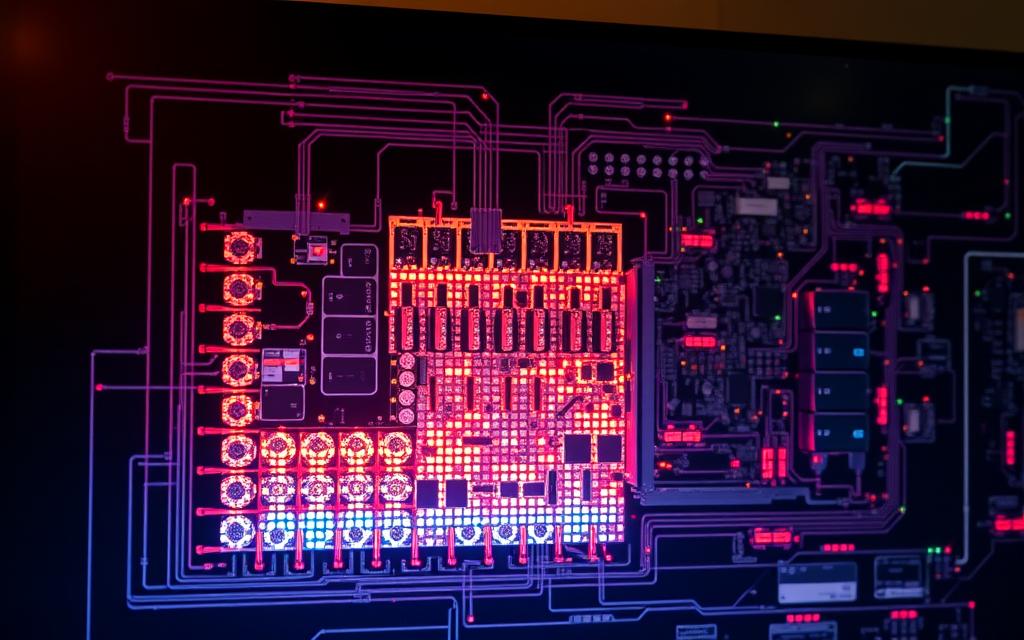
A plasma TV has millions of tiny cells between two glass panels. Each cell acts like a small light bulb filled with gases like neon and xenon.
The screen is made of:
- Front glass panel with transparent electrodes
- Gas-filled cells in a grid
- Phosphor coatings on cell walls
- Rear glass panel with address electrodes
This design lets the TV show high-quality images.
Pixel Illumination and Colour Production
Plasma TVs work magic when electricity flows through the cells. This electricity makes the gas inside the cells turn into plasma. This plasma then gives off ultraviolet light.
The UV light hits phosphor coatings on the cell walls. These coatings make the three main colours:
| Phosphor Type | Colour Produced | Chemical Composition |
|---|---|---|
| Red Phosphor | Red | Yttrium oxide |
| Green Phosphor | Green | Zinc silicate |
| Blue Phosphor | Blue | Barium magnesium aluminate |
This process happens thousands of times a second. It makes the moving images we see. The brightness of each colour depends on the electrical charge. This lets the TV show deep blacks and precise colours, loved by home cinema fans.
Medical Sterilization Using Plasma Technology
In healthcare, keeping things clean is key for patient safety. Plasma technology is a new way to do this. It uses cold atmospheric plasma systems that work at room temperature.
The Process of Plasma Sterilization
Cold plasma sterilisation is a complex process. Medical tools are put in a special chamber. Here, gas molecules turn into ions.
This ionisation makes reactive oxygen and nitrogen species (RONS) and ultraviolet radiation. These work together to kill germs. They damage DNA, proteins, and cell membranes, and oxidise cells.
The whole process takes 30-60 minutes. It uses no high heat or harmful chemicals. This is great for delicate tools that can’t handle traditional methods.
Advantages Over Traditional Sterilization Methods
Plasma sterilisation has big advantages over old methods. It’s perfect for today’s medical needs.
Material compatibility is a big plus. Unlike autoclaving, cold plasma doesn’t harm sensitive materials. Tools like endoscopes and electronic parts stay safe.
This method leaves no toxic residues. You don’t need to rinse or aerate like with chemicals. This saves time and keeps everyone safe.
Cold plasma is very good at killing tough germs and viruses. It’s as effective as the best old methods but without their downsides.
It’s also good for the environment. Plasma systems use less energy than steam autoclaves and don’t make harmful waste. This supports green healthcare.
Cold atmospheric plasma-aerosol (CAP-A) is a great new option. It’s better than old methods for delicate devices because it’s not hot, toxic, or radioactive. CAP-A kills germs and viruses well without damaging materials.
More healthcare places are using plasma technology. It’s safe and versatile. The tech is getting better, making it even more useful for keeping things clean in healthcare.
Other Medical Applications of Plasma
Plasma technology is not just for sterilisation. It has many uses in medicine, making patient care better and treatments more effective.
Wound Healing and Tissue Regeneration
Plasma medicine is great for speeding up wound healing. It uses cold atmospheric plasma to help cells grow and kill bacteria at the wound site.
This method helps wounds heal faster. It works by starting healing signals in cells without harming the good tissue around them.
Studies show wounds treated with plasma heal better. They have less inflammation and more collagen. This is good for long-lasting wounds and burns.
Dental and Surgical Uses
Dental applications of plasma are changing oral care. Dentists use plasma to clean root canals better than before. It gets rid of germs that other methods might not catch.
In surgery, plasma helps remove tissue carefully. This means less damage to the area and quicker recovery times. It also helps in making dental implants work better by improving bone attachment.
Plasma is also being looked at for cancer treatment. It might be able to kill cancer cells without harming healthy ones. This could be a new way to fight cancer.
But, using plasma on liquids is harder than on surfaces. Scientists are working hard to solve these problems. This will help plasma be used in even more medical ways.
Industrial Uses of Plasma Technology
Plasma technology is not just for medical and consumer use. It plays a key role in many industrial areas. These systems use plasma’s special properties to change how things are made and help the environment.
Surface Treatment and Material Processing
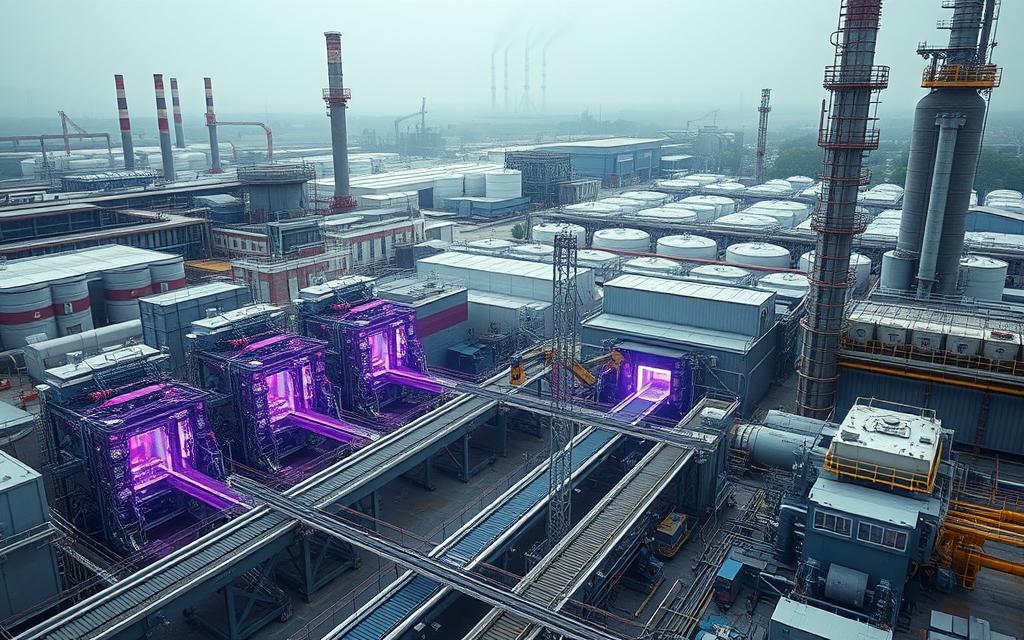
Industrial plasma systems change how materials are prepared and changed. They make surfaces super clean for sticking, coating, or printing.
Plasma treatment does many important things:
- It removes organic dirt through oxidation
- It makes surfaces better for sticking things to them
- It creates tiny structures for better coating
- It adds special groups to surfaces
The car industry uses plasma to get plastics ready for paint. Electronics makers use it to clean parts for bonding.
Waste Management and Environmental Applications
Plasma technology helps protect the environment and manage waste. It can break down tough materials that other methods can’t.
One big use is in medical waste disposal. Plasma systems kill harmful germs without making bad stuff. This is safer than burning or using chemicals.
Another area is water cleaning. Plasma treatment kills germs in water without chlorine’s dangers. Cities are starting to use it for cleaner water.
| Application Area | Plasma Technology Used | Key Benefits |
|---|---|---|
| Surface Preparation | Atmospheric Plasma | Improved adhesion, reduced chemical use |
| Medical Waste Treatment | Thermal Plasma Torch | Pathogen destruction, volume reduction |
| Water Purification | Non-Thermal Plasma | Chemical-free disinfection, no byproducts |
| Exhaust Gas Treatment | Plasma Catalysis | Pollutant breakdown, energy efficiency |
These examples show how versatile plasma technology is. It’s used for making better surfaces and solving environmental problems. Plasma solutions are growing in many fields.
Benefits of Plasma Technology Across Sectors
Plasma technology is changing the game in medical, industrial, and consumer fields. It offers benefits that traditional methods can’t match. This makes plasma systems a top choice for those aiming for top-notch performance and eco-friendly operations.
Efficiency and Precision
Plasma technology is a game-changer when it comes to efficiency. It uses energy in a precise way, unlike old methods that waste a lot. This means plasma systems get great results with less energy.
Its precision is unmatched. Plasma treatment can work on sensitive materials without causing damage. This reduces waste and boosts efficiency in many industries.
In medicine, plasma’s precision shines during sterilisation. It can clean complex medical tools without harming them. This is a big win for hospitals.
For industries, plasma’s surface treatment skills are a game-changer. It helps manufacturers get better results faster and with less energy.
Safety and Environmental Friendliness
Plasma tech works at room temperature and normal pressure. This means no need for hot processes, making it safer and more energy-efficient.
Cold plasma disinfection is a big step forward for the environment. It uses no harmful chemicals, making it safe for people and nature.
Most importantly, plasma is safe for people. Unlike many old disinfection methods, it doesn’t need areas to be cleared out.
Plasma also has big environmental pluses. It doesn’t create toxic waste or leave harmful residues. This makes it a key player in sustainable practices.
This mix of safety and eco-friendliness makes plasma a smart choice for forward-thinking companies. They want to do well and do good for the planet.
Challenges and Limitations of Plasma Technology
Plasma technology is impressive in many fields, but it faces big challenges. These include technical and economic hurdles that slow its adoption. Both issues are critical and need to be solved.
Technical and Economic Barriers
One major challenge is making plasma work with delicate materials like living tissues. It’s hard to meet strict temperature and density standards. This requires careful engineering.
Creating systems that keep these conditions is a big technical problem. It’s a major hurdle for using plasma in medicine.
Economic barriers also block wider use of plasma technology. The cost of special equipment is high, making it hard for many to afford. Budget limits often stop organisations from adopting this technology.
Scaling up from lab to industrial use is another economic issue. Moving from small-scale success to large-scale operations needs more research and money.
Current Research and Development Needs
To tackle these challenges, focused R&D is needed. Scientists are working to make plasma systems more efficient and affordable. They aim to keep costs low while keeping precision high.
Improving plasma source design is a key area of research. Scientists are looking at new electrode designs and power systems. This will help make plasma more stable and consistent.
Another important area is making plasma systems more affordable. Researchers are exploring cheaper materials and ways to use less energy. This will help make plasma technology more accessible.
Investment in standardisation and safety is also vital. As plasma technology grows, clear rules and safety standards are needed. This will help the industry accept it more widely.
Future Trends in Plasma Technology
Plasma technology is growing fast, leading to big changes in many areas. We’re seeing new ways to improve healthcare, electronics, and how we tackle environmental issues.
Innovations in Healthcare and Electronics
Medical uses of plasma are very promising. Scientists are making better, smaller devices for treating wounds and cleaning surfaces. These new tools are better than old methods.
Cold atmospheric plasma (CAP) is a big step forward. It’s safer than harsh chemicals and works well without damaging surfaces. This makes it great for cleaning and sterilising.
In electronics, plasma is helping make screens thinner and more efficient. We’re also seeing better semiconductors. The future looks bright with flexible screens, better energy use, and new ways to use technology.
Potential New Applications
Plasma technology is also set to enter new fields. It could be used in air purifiers to kill germs in public places and hospitals.
Another area is personal protective gear. Plasma masks could destroy viruses and bacteria, giving better protection than regular masks.
Other exciting uses include:
- Advanced water purification systems for communities
- Food preservation techniques that extend shelf life naturally
- Agricultural treatments that reduce pesticide use
- Energy production through plasma-assisted combustion
Plasma is becoming a key player in keeping us safe and healthy. Its gentle nature makes it perfect for places where harsh chemicals are a risk.
As research goes on, plasma will tackle new challenges. Its wide range of uses means it will keep leading in science for a long time.
Conclusion
Plasma technology is a game-changer in science. It lights up our TVs and cleans medical tools. This technology is changing many fields.
From the basics to real-world uses, plasma has made huge strides. TVs from Panasonic and Pioneer changed how we watch movies. Medical gear from STERIS and Advanced Sterilization Products is now safer. It’s also used in making materials and cleaning the environment.
This summary shows what plasma has achieved and what’s next. It’s all about being precise, efficient, and good for the planet. But, there are also challenges to overcome.
Plasma technology is becoming more important worldwide. As it keeps improving, it offers better, safer, and greener solutions. The future looks bright for this powerful technology.
FAQ
What is plasma, and how is it different from other states of matter?
Plasma is the fourth state of matter, made of ionised gas with free electrons and ions. It’s different from solids, liquids, or gases because it can conduct electricity and react to electromagnetic fields. It’s the most common form of matter in the universe, found in stars and lightning.
How is plasma created?
Plasma is made by ionising a gas with energy, like heat or strong electromagnetic fields. This strips electrons from atoms, creating an ionised state. There are two types: thermal plasma, which is hot, and non-thermal (cold) plasma, which is near room temperature and good for biological uses.
What are the key components of a plasma system?
A plasma system has a power supply, electrodes, and a gas source. These work together to create and control plasma. Plasma produces reactive species and UV radiation for various uses.
How do plasma televisions work?
Plasma TVs have tiny cells filled with inert gases. An electrical charge excites the gas, turning it into plasma. This plasma emits ultraviolet light that hits phosphors, creating the colours for the image.
How does plasma sterilisation work in medical settings?
Plasma sterilisation uses cold plasma to create reactive oxygen and nitrogen species (RONS) and UV radiation. These elements destroy microorganisms by damaging their DNA, proteins, and cell membranes. It’s a low-temperature method that’s safe and leaves no toxic residue.
What are the advantages of plasma sterilisation over traditional methods?
Plasma sterilisation works at low temperatures, making it safe for heat-sensitive materials. It doesn’t produce toxic chemical waste, is effective against antibiotic-resistant pathogens, and leaves no residue. It’s a safer and more environmentally friendly option than autoclaving or chemical disinfectants.
Can plasma technology be used for wound healing?
Yes, plasma technology can help with wound healing and tissue regeneration. It stimulates cell growth and reduces bacterial load. It’s also being explored in dentistry for disinfecting root canals and in surgery for precise tissue ablation.
What industrial applications does plasma technology have?
Plasma is used in industry for surface treatments like cleaning, etching, and improving coating adhesion. It’s also used in environmental applications, such as breaking down hazardous waste and purifying water without toxic byproducts.
What are the main benefits of using plasma technology?
Plasma technology is highly efficient and precise, allowing for targeted applications without damaging sensitive materials. It’s safe, operates at low temperatures, uses ambient air, produces no toxic waste, and leaves no residue. It’s a sustainable choice for medical, industrial, and consumer sectors.
What challenges does plasma technology currently face?
Challenges include engineering difficulties in creating dense, cold plasma jets for biological uses and the high initial cost of specialised equipment. Further research and development are needed to make the technology more accessible for widespread use.
What future developments are expected in plasma technology?
Future innovations may include more advanced, portable medical devices for wound care and sterilisation. New roles in next-generation electronics are also expected. Emerging applications could involve integration into air purification systems or personal protective equipment to combat airborne pathogens.
Is plasma technology environmentally friendly?
Yes, plasma technology is environmentally friendly. It often uses ambient air, operates without producing toxic chemical waste, and leaves no residue. Its applications in waste management and water purification offer sustainable alternatives to traditional methods.
